
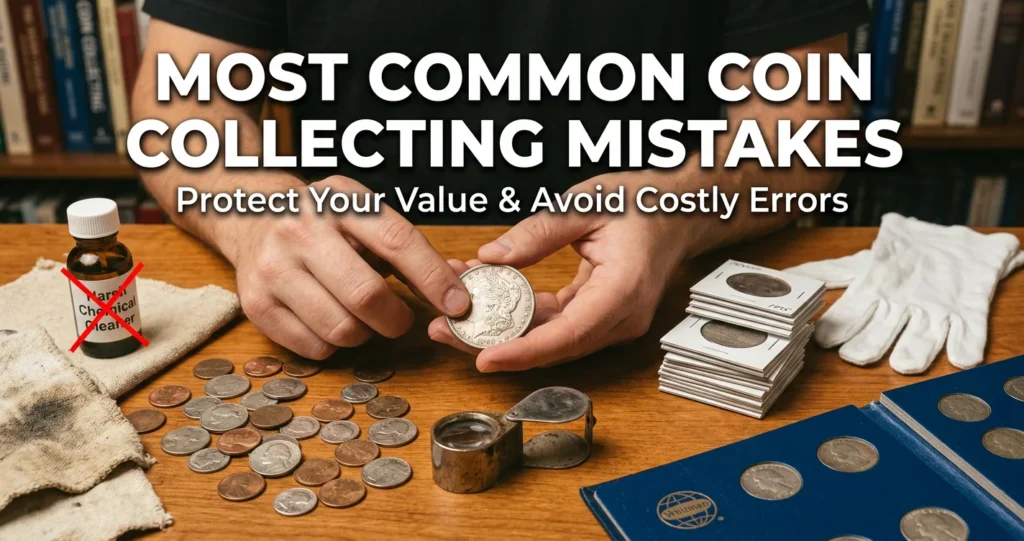
Every experienced coin collector has a story they’d rather forget. A coin cleaned with household polish before realizing what that does to value. A rare date sold for pocket change because the date wasn’t checked carefully. An expensive purchase from a disreputable dealer that turned out to be a counterfeit. A collection stored in a basement that spent twenty years quietly corroding.
These mistakes aren’t signs of stupidity — they’re the natural growing pains of learning a complex hobby. The numismatic world has its own language, its own standards, and its own pitfalls that aren’t obvious to newcomers. The problem is that in coin collecting, mistakes often have real financial consequences. Unlike most hobbies where a misstep just means wasted time, in numismatics it can mean losing hundreds or thousands of dollars.
The good news is that virtually every common mistake is preventable with the right knowledge. This guide walks through the most frequent errors coin collectors make — from absolute beginners to intermediate collectors who should know better — and shows you exactly how to avoid them.
Cleaning Your Coins
This is the single most damaging mistake in all of coin collecting, and it happens constantly. A new collector inherits a batch of old coins, notices they look dull and tarnished, and reaches for the silver polish or a household cleaner. Their intention is good: they want the coins to look their best. The result is financially devastating.
When you clean a coin — through polishing, chemical dipping, abrasive wiping, or even vigorous rubbing with a soft cloth — you destroy the microscopic surface structure that creates a coin’s original mint luster. That delicate surface, built up during the minting process, is irreplaceable. Once gone, it’s gone forever.
Professional grading services immediately identify cleaned coins and assign them “Details” grades rather than straight numerical grades. A coin labeled “MS Details, Cleaned” typically sells for 40% to 70% less than a comparable problem-free coin. A $500 coin can become a $150 coin simply because someone tried to make it shinier.
What to Do Instead
Leave your coins alone. Natural toning — even dark, unattractive toning — is preferable to cleaning in the numismatic market. If you have genuinely dirty coins with loose debris, the only acceptable intervention is a brief, gentle rinse in distilled water with absolutely no rubbing, followed by air drying. For anything beyond surface dust and loose dirt, consult a professional conservator before touching the coin.
Not Checking Dates and Mint Marks
In most coin series, the difference between a common date and a key date is a single digit or a small letter — yet that difference can represent thousands of dollars in value. Countless valuable coins have been spent, sold for melt value, or traded as common pieces because the collector simply didn’t check the specifics carefully.
Consider the 1916-D Mercury Dime versus a common 1916 Mercury Dime without a mint mark. Both are roughly the same size. Both have the same design. But one is worth $2 to $5 in circulated condition, and the other starts at $1,000 and climbs to $50,000 in high grades. The entire difference is a tiny “D” mint mark on the reverse.
The same principle applies across nearly every major U.S. coin series. The 1932-D and 1932-S Washington Quarters are worth $100 to $300 in circulated condition, while most other Washington Quarters from that era sell for $5 to $10. The 1909-S VDB Lincoln Cent is worth hundreds of times more than a 1909 Lincoln Cent without the mint mark.
What to Do Instead
Before assigning any value to a coin — or selling it, spending it, or trading it — identify the complete date and mint mark. Use a magnifying glass or jeweler’s loupe (10x magnification is standard) to examine mint marks, which can be extremely small on dimes and quarters. Cross-reference every coin against a current edition of the Red Book (A Guide Book of United States Coins) or the PCGS CoinFacts database online. This five-minute check could save you from giving away something truly valuable.
Overpaying Due to Poor Market Knowledge
Walking into a coin shop or browsing an online marketplace without knowing current market prices is like shopping for a car without knowing what cars cost. You’re entirely at the mercy of the seller’s asking price, with no way to evaluate whether it’s fair, inflated, or an actual bargain.
Coin dealers operate legitimate businesses and need to make a profit — that’s entirely reasonable. But some sellers, particularly in unregulated online marketplaces, price coins aggressively above market value, targeting buyers who don’t know better. Auction fever at coin shows can also lead collectors to bid beyond fair market value in the heat of competition.
Overpaying isn’t just a financial loss in the moment. It also means your collection starts underwater — you need significant price appreciation before you’d break even on a resale.
What to Do Instead
Research prices before you buy, every single time. The PCGS Price Guide and NGC’s online price guide provide regularly updated retail values by grade. Heritage Auctions maintains a comprehensive archive of completed sale prices — the most accurate real-world data available, since it reflects what buyers actually paid rather than what sellers hoped to receive. eBay’s completed listings (filtering for “sold” items) also provides practical market intelligence. Once you’ve done your research, you can walk into any buying situation with confidence.
Buying Without Knowing Who You’re Buying From
The coin market, unfortunately, has its share of dishonest sellers. Counterfeit coins, altered dates, artificially toned coins presented as naturally toned, and misrepresented grades are real problems that cost collectors money every year. The internet has made it easier for disreputable sellers to reach buyers who might otherwise have avoided them.
A classic example is the altered date. A common 1944 Lincoln Cent is worth a few cents. But take that coin, alter the date to read “1909-S,” and suddenly an unscrupulous seller has something they can attempt to market as a key date worth hundreds of dollars. Experienced collectors can spot these alterations, but beginners often cannot.
What to Do Instead
Buy from established, reputable sources whenever possible. Members of the American Numismatic Association (ANA) and the Professional Numismatists Guild (PNG) have agreed to ethical standards and are subject to oversight. When buying high-value coins, insist on coins certified by PCGS or NGC — the two most trusted professional grading services — rather than raw (uncertified) coins. If you’re buying online from an individual seller, check their feedback history carefully and look for red flags like vague descriptions, poor photographs, or pressure to complete the transaction quickly.
Improper Storage and Handling
Coins can be damaged not just in seconds through cleaning, but slowly over months and years through improper storage. Many collectors make storage mistakes that gradually reduce the quality — and therefore the value — of their collections without realizing what’s happening.
Common storage mistakes include:
- Using PVC-based flips. Soft, flexible plastic coin holders often contain PVC (polyvinyl chloride), which breaks down over time and deposits a damaging green, oily residue on coin surfaces. PVC damage can be difficult or impossible to remove without professional conservation.
- Storing coins near rubber bands. Rubber contains sulfur compounds that react with silver, causing accelerated and often damaging toning.
- Keeping coins in humid environments. Basements, bathrooms, and poorly ventilated spaces expose coins to humidity that promotes corrosion, particularly on copper and bronze coins.
- Storing coins loose in drawers or containers. Coins rattling against each other accumulate surface marks that reduce their grade over time.
- Touching coin surfaces with bare hands. The oils in your fingerprints leave residue that can develop into permanent etching on coin surfaces if not addressed, gradually degrading the surface.
What to Do Instead
Store coins in non-PVC holders — Mylar flips, hard acrylic capsules, or certified holders from PCGS or NGC. Keep your collection in a stable, climate-controlled environment with low humidity. Always handle coins by their edges, never touching the obverse or reverse faces. For a growing collection, invest in a proper coin cabinet or album designed for numismatic storage using archival-quality materials.
Collecting Without a Focus or Strategy
Many beginners buy coins indiscriminately — a little bit of everything that catches their eye. A Buffalo Nickel here, a Morgan Dollar there, some foreign coins, a commemorative set, a few silver rounds. The result is a scattered accumulation rather than a coherent collection, and scattered accumulations are notoriously difficult to sell at fair value.
Dealers and auction houses price collections more favorably when they tell a coherent story. A complete set of Mercury Dimes, or a systematic collection of Morgan Dollars by date and mint mark, or a focused assembly of Walking Liberty Half Dollars in consistent grade — these attract serious collector buyers who will pay real money. A bag of random coins from six different series attracts only dealers looking to buy at wholesale.
What to Do Instead
Choose a specialty and pursue it deliberately. Pick a series, denomination, era, or theme that genuinely interests you and learn everything about it. Read the specialized reference books for that series. Join online communities focused on that specialty. Attend shows with your area of focus in mind. Depth of knowledge in a single area will serve you far better than superficial familiarity with everything. And when you eventually decide to sell, a focused collection will bring meaningfully better prices than a miscellaneous accumulation.
Ignoring Coin Grading Fundamentals
Buying coins without understanding the grading scale is like buying a used car without knowing what good and bad condition look like mechanically. You’ll make decisions based on incomplete information, almost certainly overpay for some coins and miss the significance of others.
Grading isn’t just about knowing the numbers from 1 to 70. It’s about understanding what makes a coin grade MS-64 versus MS-65, why that single point can represent a 100% price premium, and how to evaluate the specific factors — strike, luster, surface marks, eye appeal — that determine where a coin lands on that scale.
What to Do Instead
Invest time in learning to grade before investing significant money in coins. The ANA Grading Guide provides detailed descriptions and photographs for every grade level across all major coin types. PCGS CoinFacts and NGC’s Coin Explorer both offer extensive databases of graded coins with high-resolution photographs — an invaluable resource for developing your eye by comparing your assessments against certified grades. Consider attending an ANA grading seminar if you’re serious about developing this skill systematically.
Neglecting to Verify Coin Authenticity
Counterfeit coins are more sophisticated than most people realize. Modern counterfeiting techniques, particularly from overseas operations, can produce fakes that fool casual observers completely. Counterfeit Morgan Dollars, Double Eagles, and key-date Lincoln Cents are the most commonly encountered forgeries, but virtually no series is immune.
Common authenticity red flags include:
- Weight that doesn’t match the coin’s specifications (a precision scale accurate to 0.01 grams is an essential tool)
- Dimensions slightly off from authentic coins
- Surface texture that looks wrong under magnification
- Lettering or design details that appear mushy, doubled, or incorrectly spaced
- Unusual magnetic properties (genuine U.S. silver and gold coins are not magnetic)
- Price significantly below market value — if a deal seems too good to be true, it almost certainly is
What to Do Instead
For any significant purchase of a raw (uncertified) coin, verify authenticity before completing the transaction. A basic precious metals testing kit, digital scale, and calipers are affordable tools that catch many fakes. For valuable coins, require PCGS or NGC certification before purchasing — counterfeiting a certified coin in its sealed holder is extremely difficult and immediately obvious. If you’re uncertain about a coin’s authenticity, consult a knowledgeable dealer or submit the coin to a professional grading service before buying.
Selling at the Wrong Time and Place
Collectors who need to sell their coins often make the mistake of choosing convenience over value. Walking into the first coin shop and accepting an immediate offer, selling to a pawnshop, or listing coins without research on a low-traffic platform can cost you 30% to 60% of your coins’ true market value.
Coin dealers are in business to make a profit. They need to buy below retail and sell at retail to sustain their operations. Typical dealer buy prices for common bullion coins run 15% to 25% below retail. For rare coins, dealers may offer 60% to 70% of retail value, since they need margin for their time, overhead, and the market risk of holding inventory.
None of this makes dealers dishonest — it’s simply how business works. But it means that selling to a dealer is rarely the way to maximize your return.
What to Do Instead
Match your selling venue to your coin’s value and rarity. Common bullion coins sell efficiently on established online platforms with competitive pricing. Rare and high-grade numismatic coins achieve their best prices at major auction houses — Heritage Auctions, Stack’s Bowers, and Great Collections all have large, motivated collector audiences who compete actively for quality material. For mid-range coins, collector-to-collector sales through numismatic clubs, online forums, and coin shows often yield better results than dealer offers. Always get multiple opinions on value before committing to any sale.
Letting Emotion Drive Purchasing Decisions
The thrill of the hunt is part of what makes coin collecting wonderful. But that same excitement, if left unchecked, leads to impulsive purchases that you later regret. Buying a coin because you “had to have it” rather than because the price and quality were right is a recipe for a collection filled with mediocre coins purchased at premium prices.
Auction environments are particularly dangerous for emotional decision-making. The competitive atmosphere, time pressure, and visible bidding from other collectors can push prices well beyond fair market value. Post-auction regret — realizing you paid 40% above a coin’s catalog value in the heat of bidding — is a painful and common experience.
What to Do Instead
Set a maximum price before you enter any buying situation and commit to honoring it. Before an auction, research the specific coin’s recent sale prices and determine what it’s worth to you. Write that number down. When bidding reaches your limit, stop — regardless of how much you want the coin. The numismatic market offers a constant supply of opportunities. If you miss one coin, another will appear. The collector who buys patiently and strategically builds a far better collection than one who buys impulsively at any price.
Underestimating the Importance of Reference Materials
Many collectors try to navigate the numismatic world through general online searches and casual reading, never investing in the specialized reference books that serious collectors consider essential. This approach leaves significant knowledge gaps that cost money in both buying and selling situations.
Every major coin series has specialized reference works that go far beyond general price guides. These books document die varieties, overdates, repunched mint marks, and other collectible varieties that can multiply a common coin’s value. A coin worth $50 as a regular issue might be worth $500 as a recognized variety — but only if you know to look for it.
What to Do Instead
Invest in quality reference materials for your collecting specialty. Essential starting points include the Red Book (annual, covers all U.S. coins), the ANA Grading Guide, and whatever specialized references exist for your series — the Cherrypickers’ Guide for varieties across U.S. coins, Q. David Bowers’ Morgan Dollar encyclopedia for that series, or the Flynn reference for Walking Liberty Half Dollars. These books pay for themselves repeatedly through the knowledge they provide.
A Quick Summary: Common Mistakes and Simple Solutions
| Mistake | Consequence | Solution |
| Cleaning coins | Permanent value loss of 40–70% | Never clean; consult professionals for conservation |
| Ignoring dates and mint marks | Missing key dates worth thousands | Check every coin with a loupe and reference guide |
| Overpaying for coins | Collection starts underwater financially | Research prices before every purchase |
| Buying from disreputable sources | Counterfeits, altered coins, misrepresented grades | Buy from ANA/PNG members; require PCGS/NGC certification |
| Improper storage and handling | Gradual condition degradation over time | Use archival materials; handle by edges only |
| No collecting focus | Difficult to sell; lower realized values | Choose a specialty and pursue it deliberately |
| Ignoring grading fundamentals | Poor buying decisions; overpaying for grade | Study grading guides; compare against certified examples |
| Skipping authenticity verification | Buying counterfeit or altered coins | Weigh, measure, and require professional certification |
| Selling at wrong venue | Receiving 40–60% below true market value | Match selling venue to coin type and value |
| Emotional purchasing | Overpaying; collection of mediocre coins | Set maximum prices before entering buying situations |
Frequently Asked Questions About Coin Collecting Mistakes
1. I already cleaned some of my coins. Is the damage reversible?
Unfortunately, in most cases the damage from cleaning is permanent. Once a coin’s original luster and surface structure are disturbed by cleaning, they cannot be genuinely restored. Professional coin conservation services can sometimes improve the appearance of coins with certain types of problems — removing harmful PVC deposits or stabilizing active corrosion, for instance — but they cannot replace destroyed luster or erase hairlines caused by polishing. The best these services can do is halt further damage and improve the coin’s visual presentation modestly. This is precisely why the rule against cleaning is so absolute: there’s no undo button.
2. How do I know if a coin dealer is reputable?
Start by checking for professional affiliations. Membership in the American Numismatic Association (ANA) or the Professional Numismatists Guild (PNG) indicates a commitment to ethical standards and provides a mechanism for dispute resolution if problems arise. Online reviews, particularly on specialized numismatic forums like the NGC Forum or PCGS Forums, reflect real collector experiences. Longevity in business is another positive indicator — dealers who have operated for decades in the same community have earned their reputation through consistent honest dealing. Be cautious of dealers who pressure you to complete transactions quickly, offer unusually high buy prices to acquire your coins, or seem reluctant to allow you time to research before buying.
3. What’s the most expensive mistake beginners typically make?
Cleaning a genuinely rare and valuable coin is probably the costliest single mistake. Imagine discovering you have a 1909-S VDB Lincoln Cent worth $1,500 to $2,000 in Fine condition — then cleaning it, reducing its value to $500 or $600 as a “Details, Cleaned” coin. That’s $1,000 or more lost in minutes. A close second is selling a valuable coin without proper identification. Collectors regularly spend coins, sell collections to dealers at bullion prices, or trade key dates without recognizing their significance. The preventative medicine for both mistakes is the same: learn before you act, and when uncertain, consult an expert before doing anything irreversible.
4. Is buying coins on eBay a good idea for beginners?
eBay can be a reasonable marketplace for beginners, but it requires caution and knowledge to use safely. The platform’s buyer protection policies provide some security, but they don’t prevent you from overpaying or buying misrepresented coins. Stick to sellers with strong, established feedback records and many completed transactions. Avoid raw (uncertified) coins of significant value until you develop enough experience to evaluate them confidently. For higher-value coins, limiting your eBay purchases to PCGS or NGC certified examples eliminates most of the authenticity and grade risk. Always cross-reference the asking price against PCGS and Heritage price data before bidding.
5. How should I handle coins I’ve inherited without knowing their value?
The most important first step is to avoid doing anything irreversible — particularly cleaning — until you understand what you have. Place the coins in basic protective storage (non-PVC flips or small plastic capsules) and begin the identification process methodically. Sort coins by denomination, then examine each one for date and mint mark using a magnifying glass. Use the Red Book or PCGS CoinFacts to check whether any dates are potentially significant. For any coins that appear to be key dates, high-grade uncirculated examples, or otherwise potentially valuable, consult a reputable local dealer or consider professional submission to PCGS or NGC before making any selling decisions. Many inherited collections contain genuine surprises — both pleasant and disappointing — and patience before acting protects you from costly mistakes in either direction.
Conclusion
Coin collecting is a hobby that generously rewards knowledge and consistently punishes ignorance — not out of any malice, but simply because the market is sophisticated and mistakes have real financial consequences. The collectors who thrive over the long term are those who invest in learning as seriously as they invest in coins.
The mistakes covered in this guide aren’t obscure pitfalls that only extreme beginners fall into. They’re patterns that repeat across collectors at all experience levels, and the most experienced numismatists will tell you they’ve made several of them at some point in their collecting journey. What separates successful collectors isn’t the absence of mistakes — it’s learning from them quickly and putting protective habits in place before those mistakes become expensive.
Protect your coins’ surfaces. Know what you’re buying before you buy it. Understand the market you’re operating in. Build knowledge as deliberately as you build your collection. These habits don’t guarantee you’ll never make a mistake, but they dramatically reduce the frequency and cost of the mistakes you do make.
The numismatic world is rich, fascinating, and genuinely rewarding for those who approach it with patience and respect for its complexity. Take the time to learn, build relationships with trustworthy dealers and fellow collectors, and treat every coin as the irreplaceable historical artifact it is. Your collection — and your bank account — will be better for it.