
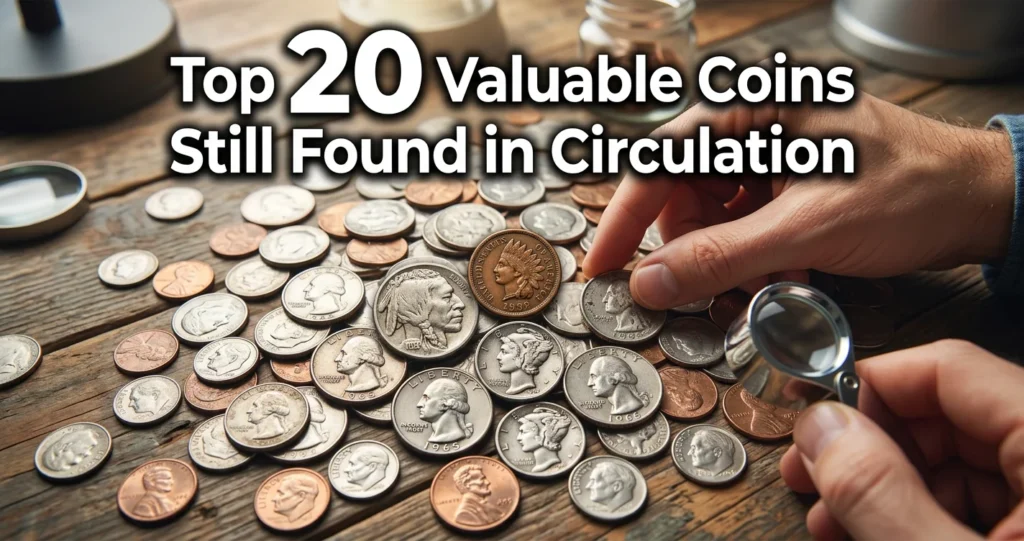
Most people walk past small fortunes every day without realizing it. The handful of change sitting in your cup holder, the coins dropped into a tip jar, the quarters fed into a parking meter — any of them could be worth far more than face value. It sounds like wishful thinking, but people genuinely do find valuable coins in everyday circulation, and it happens more often than you might expect.
The United States Mint has produced billions of coins over the decades, and among that ocean of ordinary pocket change, certain error coins, low-mintage varieties, and overlooked older pieces continue to surface. Some are worth a few dollars above face value. Others are worth hundreds. A small number have sold for thousands.
You don’t need a metal detector, an auction catalog, or a trust fund to start finding valuable coins. You need sharp eyes, a basic understanding of what to look for, and the patience to check your change consistently. This guide covers twenty specific coins that are still being pulled from circulation today, along with what makes them valuable and what you should expect them to sell for.
Why Valuable Coins Are Still in Circulation
It seems counterintuitive that coins worth hundreds of dollars would still be floating around in cash registers and coin rolls. But the explanation is straightforward: most people don’t look at their change. A quarter is a quarter to them. They don’t flip it over, examine the mint mark, or scrutinize the design for anomalies. Valuable coins pass through hundreds or thousands of hands unnoticed until someone who knows what to look for finally spots them.
Error coins are particularly likely to survive in circulation because they look similar enough to normal coins that neither the mint’s quality control nor the general public catches them. A doubled die penny still spends like a regular penny. A quarter struck on the wrong planchet still works in a vending machine. These coins hide in plain sight for years or decades.
The Top 20 Valuable Coins You Might Find Today
1. 1969-S Doubled Die Obverse Lincoln Cent
This is one of the holy grails of circulation finds. The doubling on this coin is dramatic — the date, “LIBERTY,” and “IN GOD WE TRUST” all show clear secondary images. The Mint reportedly destroyed most examples when the error was discovered, making survivors genuinely scarce. Circulated examples have sold for $25,000 to $50,000. Finding one would be life-changing for any coin hunter, and they do still surface occasionally from old hoards and accumulated change.
2. 1970-S Small Date Lincoln Cent
The 1970-S Lincoln Cent exists in two varieties: a common “Large Date” and a scarce “Small Date.” The Small Date version was struck on leftover 1969 planchets and shows a noticeably different date style. In uncirculated condition, these sell for $40 to $75. Even well-worn examples bring $15 to $30 — remarkable for a coin worth one cent at face value.
3. 1972 Doubled Die Obverse Lincoln Cent
After the famous 1955 and 1969-S doubled dies, the 1972 doubled die is the most prominent in the Lincoln Cent series. The doubling is visible on the date and lettering without magnification. Values range from $100 to $500 in circulated grades and can exceed $1,000 in uncirculated condition. These turn up in circulation periodically because their doubling, while clear, is less dramatic than the 1955 version and easier to overlook casually.
4. 1982 No Mint Mark Roosevelt Dime
In 1982, the Philadelphia Mint accidentally produced a small number of Roosevelt Dimes without the “P” mint mark that had been standard on Philadelphia dimes since 1980. This was the first and only time a Roosevelt Dime from Philadelphia lacked a mint mark after the practice began. Circulated examples sell for $50 to $150. Uncirculated specimens bring $200 to $400 or more.
5. 1995 Doubled Die Obverse Lincoln Cent
The doubling on this coin is most visible on the word “LIBERTY” and is easily spotted with a basic magnifying glass. Because the coin is relatively recent, many examples remain in circulation. Circulated finds typically sell for $20 to $50, while uncirculated examples command $50 to $100. This is one of the most realistic valuable finds for everyday coin searchers.
6. 2004 Wisconsin State Quarter — Extra Leaf Varieties
A small number of 2004-D Wisconsin State Quarters were struck from dies that show an extra leaf on the ear of corn depicted on the reverse. Two distinct varieties exist: the “Extra Leaf High” and the “Extra Leaf Low.” Both are widely collected and sell for $100 to $300 depending on condition and variety. These quarters are still actively pulled from circulation and remain one of the most sought-after modern error coins.
7. 1999-P Connecticut Broadstruck Quarter
Broadstruck coins are produced when the retaining collar fails during striking, allowing the coin to spread beyond its normal diameter. While broadstrike errors exist for many dates, 1999 State Quarters — particularly from Philadelphia — are among the most frequently encountered. Values range from $25 to $200 depending on severity and condition. Any State Quarter that looks slightly too large or has a missing or distorted rim is worth examining closely.
8. 1983 Doubled Die Reverse Lincoln Cent
This variety shows clear doubling on the reverse lettering, particularly “UNITED STATES OF AMERICA” and “ONE CENT.” It’s often overlooked because most collectors focus on the obverse when checking for doubled dies. Circulated examples sell for $100 to $300, and uncirculated coins can reach $500 or more. The 1983 Lincoln Cent already has collector interest because it was the first year all cents were struck on copper-plated zinc planchets.
9. Silver Roosevelt Dimes (1946–1964)
Pre-1965 silver dimes occasionally appear in circulation, usually because someone unknowingly spent a coin jar or because a silver dime was mixed into a bank roll. Any Roosevelt Dime dated 1964 or earlier contains 90% silver and is worth approximately $2 to $3 at current silver prices — far above its ten-cent face value. While not dramatically valuable individually, finding silver dimes is a common and satisfying experience for coin roll hunters.
10. Silver Washington Quarters (1932–1964)
Like silver dimes, pre-1965 Washington Quarters surface in circulation with surprising regularity. Each contains approximately 0.18 troy ounces of silver, giving them a melt value of roughly $5 to $7 depending on the current silver price. Certain dates, particularly the 1932-D and 1932-S, are significantly more valuable — worth $100 or more even in heavily worn condition. Always check the date on older-looking quarters before spending them.
11. 1964 Kennedy Half Dollar
The 1964 Kennedy Half Dollar is 90% silver and worth approximately $8 to $12 based on silver content alone. While half dollars circulate less frequently than smaller denominations, they do appear — particularly in bank-wrapped rolls, which coin roll hunters specifically target. The 1964 Kennedy is the most common 90% silver half dollar you’ll encounter, but its silver value makes every find worthwhile.
12. 1965–1970 Kennedy Half Dollar (40% Silver)
After 1964, Kennedy Half Dollars were produced with 40% silver content through 1970. These coins are worth $3 to $5 each based on their reduced but still meaningful silver content. Many people don’t realize that half dollars from this date range contain any silver at all, so these coins continue to circulate and appear in bank rolls regularly.
13. 2005-D Speared Bison Jefferson Nickel
This popular variety shows a die gouge that creates what appears to be a spear running through the bison on the reverse of the 2005 Westward Journey nickel. The dramatic visual effect makes it a collector favorite. Circulated examples sell for $15 to $50, and finding one requires nothing more than careful examination of the reverse of 2005-D nickels.
14. 2000-P Sacagawea Dollar / Washington Quarter Mule
This is one of the rarest and most valuable coins that has ever appeared in circulation. A small number of coins were struck with a Sacagawea Dollar obverse and a Washington Quarter reverse — a minting error called a “mule” because it combines two different coin designs. Only about a dozen are known to exist, and they’ve sold for $50,000 to $150,000. The odds of finding one are astronomically low, but every confirmed example entered circulation through normal channels.
15. 1992 Close AM Lincoln Cent
Standard 1992 Lincoln Cents for circulation use the “Wide AM” reverse design, where the letters A and M in “AMERICA” are clearly separated. A small number were accidentally struck using the proof die with the “Close AM” design, where the two letters nearly touch. These error coins sell for $5,000 to $20,000 depending on condition. The difference is subtle but identifiable with a magnifying glass, and these coins have been found in ordinary pocket change.
16. 1998-S Close AM Lincoln Cent
Similar to the 1992 variety but even rarer, the 1998 Close AM cent used a proof reverse die on a business strike coin. Values range from $5,000 to over $25,000. Fewer than a dozen confirmed examples are known. Checking the spacing between the A and M on any 1998 Lincoln Cent takes only seconds but could yield an extraordinary find.
17. 1999 Wide AM Lincoln Cent
This is the reverse of the previous two errors. In 1999, the standard business strike design used the Close AM, but a small number were struck with the Wide AM proof die. Values range from $400 to $1,500. More examples of this variety have been found than the 1992 and 1998 versions, making it a more realistic — though still exciting — potential discovery.
18. 2005 Minnesota State Quarter — Extra Tree Varieties
Some 2005 Minnesota Quarters show extra trees or doubled die elements in the forested landscape on the reverse. The most dramatic examples, with clearly visible additional tree lines, sell for $50 to $200. Less pronounced varieties bring $10 to $30. Like other State Quarter errors, these continue to circulate and can be spotted with careful reverse examination.
19. Nickel-Clad Dime Struck on Cent Planchet
Wrong-planchet errors — coins struck on a planchet intended for a different denomination — are among the most dramatic and valuable mint errors. A dime struck on a copper cent planchet will be noticeably off-color (copper instead of silver-toned) and slightly undersized. These errors are worth $200 to $1,000 depending on the date and condition. While no specific date dominates, wrong-planchet dimes from various years continue to surface in circulation.
20. Off-Center Strikes (Various Denominations)
Off-center strikes occur when a planchet isn’t properly seated in the striking chamber, resulting in a coin with part of the design missing and a crescent-shaped blank area. The value depends on the percentage of off-center displacement and whether the date is still visible. A 10% off-center coin might be worth $10 to $20. A 50% off-center coin with a readable date can bring $100 to $500 or more. These errors occur across all denominations and time periods, making them among the most frequently encountered valuable errors in circulation.
Complete Value Reference Table
| Coin | What to Look For | Approximate Value |
| 1969-S Doubled Die Cent | Strong doubling on obverse lettering and date | $25,000–$50,000 |
| 1970-S Small Date Cent | Smaller, thinner date font compared to Large Date | $15–$75 |
| 1972 Doubled Die Cent | Visible doubling on date and obverse text | $100–$1,000 |
| 1982 No-P Roosevelt Dime | Missing “P” mint mark on obverse | $50–$400 |
| 1995 Doubled Die Cent | Doubling on “LIBERTY” | $20–$100 |
| 2004-D Wisconsin Extra Leaf Quarter | Extra leaf on corn ear (high or low position) | $100–$300 |
| Broadstruck State Quarters | Oversized diameter, distorted rim | $25–$200 |
| 1983 Doubled Die Reverse Cent | Doubling on reverse lettering | $100–$500 |
| Silver Roosevelt Dimes (pre-1965) | Date 1964 or earlier | $2–$3+ |
| Silver Washington Quarters (pre-1965) | Date 1964 or earlier | $5–$7+ |
| 1964 Kennedy Half Dollar | Date reads 1964 | $8–$12 |
| 1965–1970 Kennedy Half Dollar | Dates in the 1965–1970 range | $3–$5 |
| 2005-D Speared Bison Nickel | Die gouge through bison on reverse | $15–$50 |
| 2000-P Sacagawea/Quarter Mule | Sacagawea obverse with quarter reverse | $50,000–$150,000 |
| 1992 Close AM Cent | A and M nearly touching in “AMERICA” | $5,000–$20,000 |
| 1998 Close AM Cent | A and M nearly touching in “AMERICA” | $5,000–$25,000 |
| 1999 Wide AM Cent | A and M clearly separated in “AMERICA” | $400–$1,500 |
| 2005 Minnesota Extra Tree Quarter | Extra tree lines on reverse landscape | $10–$200 |
| Wrong-Planchet Dime | Copper-colored dime, wrong size | $200–$1,000 |
| Off-Center Strikes (any denomination) | Missing portion of design, crescent blank area | $10–$500+ |
How to Search Your Change Effectively
Finding valuable coins in circulation isn’t about luck alone — it’s about volume and method. Here’s how experienced coin hunters maximize their chances.
Coin Roll Hunting
The most efficient way to search large quantities of coins is through coin roll hunting. Visit your bank and purchase rolls of coins — pennies come in $0.50 rolls, nickels in $2 rolls, dimes in $5 rolls, quarters in $10 rolls, and half dollars in $10 rolls. Search through each roll carefully at home, set aside anything promising, then return the unsearched coins to a different bank to avoid getting the same rolls back.
Half dollar rolls are particularly productive for silver hunters. Many banks have half dollars sitting in their vaults that rarely circulate, and these older rolls frequently contain 40% or 90% silver Kennedy Half Dollars that have sat untouched for decades.
Check Every Coin
Develop the habit of examining every coin that passes through your hands. Look at the date, check the mint mark, and glance at both sides for anything unusual. This becomes second nature quickly, adding only a few seconds to any cash transaction.
Know the Key Indicators
Train yourself to recognize the visual signatures of error coins quickly:
- Wrong color: A dime that looks coppery or a penny that looks silvery could be a wrong-planchet error.
- Wrong size: A coin that seems slightly too large or small for its denomination warrants close examination.
- Blurred or doubled text: Any lettering that appears fuzzy, shadowed, or doubled could indicate a doubled die variety.
- Missing design elements: A coin with part of its design absent might be an off-center strike or a broadstrike.
- Unusual edge: Smooth edges on a coin that should have reeding (ridges), or vice versa, suggest a minting error.
Essential Tools
You don’t need much equipment to hunt coins effectively. A 10x jeweler’s loupe costs $10 to $15 and is indispensable for examining small details. A strong desk lamp provides the lighting needed to spot subtle errors and varieties. A basic digital scale accurate to 0.1 grams helps identify wrong-planchet errors. And a current edition of the Cherrypickers’ Guide to Rare Die Varieties provides detailed descriptions and images of every major variety worth searching for.
What to Do When You Find Something
Discovering a potentially valuable coin is exciting, but what happens next matters just as much as the find itself.
Don’t Clean It
This cannot be emphasized enough. A circulated coin found in pocket change should be preserved exactly as found. Cleaning destroys value. Place the coin in a non-PVC flip or a small hard plastic capsule to protect it from further wear and handling damage.
Verify the Variety
Compare your find against published images of the variety you believe you’ve found. PCGS CoinFacts, the NGC Variety Plus database, and the Cherrypickers’ Guide all provide detailed diagnostic images showing exactly what distinguishes a valuable variety from a normal coin. Many supposed “finds” turn out to be common coins with normal die wear, machine doubling, or post-mint damage that mimics genuine errors.
Consider Professional Grading
For coins potentially worth $100 or more, professional certification from PCGS or NGC is worth the investment. The grading service authenticates the variety, assigns a grade, and encapsulates the coin in a tamper-evident holder that gives buyers confidence. A certified coin will consistently sell for more than an identical raw coin because the buyer doesn’t have to worry about authenticity.
Know the Market
Before selling, research recent sales of comparable coins in similar condition. Heritage Auctions’ archive and eBay’s completed listings give you real-world data on what buyers are actually paying. This prevents you from accepting a lowball offer and ensures you understand your coin’s fair market value.
Frequently Asked Questions
1. How realistic is it to find a valuable coin in my change?
Finding silver coins and minor error varieties is quite realistic with consistent searching. Coin roll hunters regularly pull pre-1965 silver dimes and quarters from bank rolls, and doubled die varieties like the 1995 doubled die cent turn up with reasonable frequency for dedicated searchers. Major rarities like the 1969-S doubled die or the Sacagawea/Quarter mule are extraordinarily unlikely individual finds, but they do get discovered — every confirmed example was found by someone. The key is volume: the more coins you search, the better your odds. Think of it as a numbers game where patience is the primary skill.
2. Are coin roll hunting finds really worth the time investment?
That depends entirely on your perspective. If you approach coin roll hunting purely as a financial calculation — hours spent versus value found — the economics are modest for most searchers. The average coin roll hunter might find a few silver coins per week worth $3 to $7 each and an occasional error worth $20 to $50. But many hunters enjoy the process itself: the meditative quality of sorting through rolls, the thrill of discovery, and the satisfaction of building a collection from finds rather than purchases. The occasional significant find — a rare variety worth hundreds or thousands — is a genuine possibility that keeps the hobby exciting.
3. How can I tell the difference between a genuine doubled die and machine doubling?
This is one of the most important distinctions in error coin collecting. Genuine doubled dies show rounded, shelf-like doubling where the secondary image has its own distinct raised profile. The doubling appears dimensional — it looks like a second, slightly offset design was impressed into the die. Machine doubling (also called strike doubling or ejection doubling) shows flat, shelf-less displacement where the metal appears pushed or sheared rather than struck twice. Machine doubling produces a noticeably different visual effect: the displaced metal looks thin and flat rather than fully formed. A genuine doubled die is worth a significant premium; machine doubling adds no collectible value whatsoever. Study images of confirmed doubled dies alongside examples of machine doubling until the distinction becomes clear.
4. Should I search through foreign coins mixed into my change?
Occasionally, foreign coins end up mixed in with U.S. change because they’re similar in size to American denominations. Canadian coins are the most common, and while most modern Canadian coins are worth only face value, pre-1968 Canadian silver dimes and quarters contain 80% silver and are worth several dollars each. European coins occasionally surface as well, though the transition to the Euro has made older European coins less common. It’s worth giving foreign coins a quick glance — the time investment is minimal, and you might find an older silver piece mixed in.
5. Where is the best place to sell circulation finds?
For common silver coins found in circulation, local coin shops offer the simplest transactions, typically paying 85% to 95% of melt value. For error coins and varieties, online platforms generally achieve better prices because they reach a larger audience of specialized collectors. eBay works well for coins in the $20 to $500 range, where the buyer pool is large and competitive. For significant finds worth thousands of dollars, consignment to a major auction house like Heritage Auctions exposes the coin to the most aggressive buyers and typically yields the strongest prices, even after accounting for seller’s fees.
Conclusion
The coins in your pocket are almost certainly worth exactly what they say on them. Almost. But the small possibility that one of them is something extraordinary is what makes checking your change one of the most accessible and genuinely exciting entry points into the world of numismatics.
You don’t need to spend thousands of dollars at auction to start collecting valuable coins. You don’t need specialized training or expensive equipment. You need a loupe, a lamp, a basic understanding of what to look for, and the discipline to check your change consistently rather than dumping it into a jar unexamined.
Every coin on this list was found by someone who bothered to look. The 1969-S doubled die penny that sold for tens of thousands of dollars was once just a penny in someone’s pocket. The silver quarter worth $7 was once spent at a gas station by someone who didn’t know the difference between a 1963 quarter and a 1973 quarter. These coins exist. They circulate. And they wait to be discovered by someone who knows what they’re holding.
Start looking today. Your next piece of change might be the most valuable coin you’ll ever own.