
You’ve just found an old coin in a drawer, inherited a collection from a family member, or pulled something unusual from a roll of quarters at the bank. The first thing most people do is reach for their phone and search for a coin value calculator online. Within seconds, dozens of tools and websites promise to tell you exactly what your coin is worth.
But here’s the thing: some of those tools are genuinely useful, some are misleading, and a few are so oversimplified they’re essentially useless for making real financial decisions. Knowing the difference — and understanding how these estimators actually work — can save you from significantly undervaluing or overvaluing what you have.
This guide takes you behind the scenes of online coin value calculators, explains the methodology these tools use, identifies their strengths and limitations, and shows you how to combine digital tools with real-world knowledge for the most accurate coin valuations possible.
What Is a Coin Value Calculator?
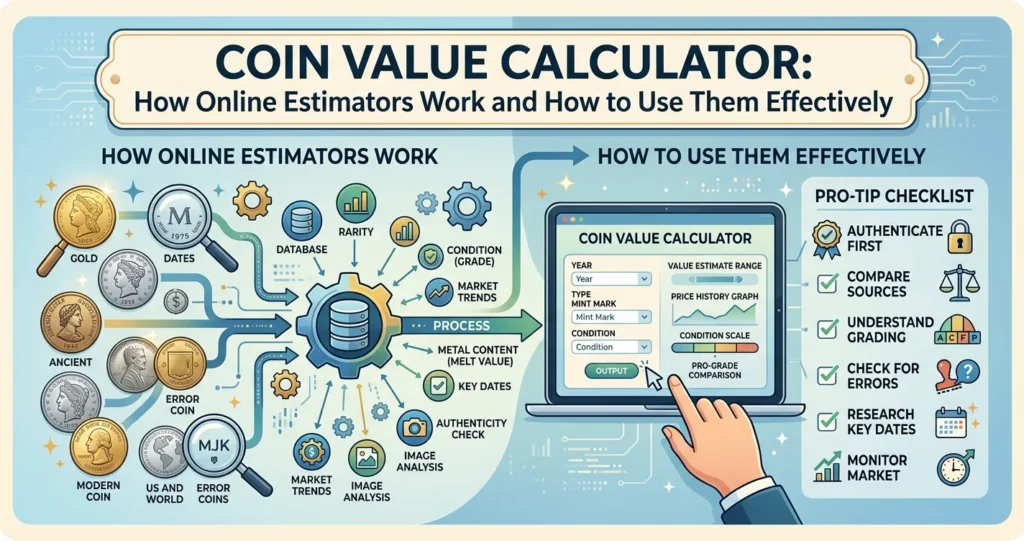
A coin value calculator is a digital tool — found on websites, apps, or as part of larger numismatic databases — that estimates the market value of a coin based on inputs provided by the user. At minimum, these tools require you to identify the coin’s denomination, country of origin, year, and sometimes the mint mark. More sophisticated tools also ask for the coin’s condition or grade.
The output is an estimated value, which might be expressed as a single number, a range, or a value that varies by grade. Some tools also provide melt values for coins containing precious metals, historical mintage data, and links to recent auction results.
Coin value calculators aren’t magic. They’re database-driven tools that match your inputs against stored pricing data. Understanding how that data is compiled — and how current it is — is the key to interpreting results intelligently.
How Online Coin Value Estimators Actually Work
The Database Foundation
Every coin value calculator is built on a database. The quality, depth, and freshness of that database determines how useful the tool actually is. Professional-grade databases like those maintained by PCGS (Professional Coin Grading Service) and NGC (Numismatic Guaranty Company) contain pricing data for tens of thousands of individual coin varieties across hundreds of series, updated regularly based on actual market transactions.
Smaller or less sophisticated tools may pull from static databases that were last updated months or years ago, reference a single price source, or use simplified grade categories that don’t capture the full range of the Sheldon 1-70 grading scale.
Price Data Sources
The prices in these databases come from several sources, each with its own characteristics:
- Auction records: Results from major coin auction houses like Heritage Auctions, Stack’s Bowers, and Great Collections represent actual transaction prices — what real buyers paid for specific coins on specific dates. This is the most reliable market data available because it reflects genuine supply and demand.
- Dealer retail prices: Published dealer ask prices represent what you’d pay buying from a dealer. These prices typically run 10% to 30% above actual transaction values, representing the dealer’s margin.
- Published price guides: The Red Book (A Guide Book of United States Coins) and similar annual publications compile pricing data from dealer networks and auction results. These guides are useful references but can lag behind rapidly moving markets.
- Spot metal prices: For coins containing gold, silver, or platinum, calculators pull live or near-live precious metals spot prices to compute melt values. This component updates continuously as commodity markets fluctuate.
The Matching Process
When you enter a coin’s details into an estimator, the tool performs a database lookup — matching your inputs (denomination, year, mint mark, condition) against stored records to retrieve an associated value or value range. More sophisticated tools can handle nuanced requests like die varieties, special designations, and error coins. Basic tools may only recognize standard date and mint mark combinations.
The result is only as accurate as the match quality. If you enter “1921 Morgan Dollar” without specifying the mint mark, the tool might return an average value that doesn’t account for the significant premium that a 1921-S or 1921-D commands over the common 1921 Philadelphia issue. Precision in your inputs directly affects the usefulness of the output.
Condition Weighting
Condition is where most basic coin value calculators fall short. The relationship between a coin’s grade and its value is not linear — the difference between MS-64 and MS-65 can represent a 100% price premium on many popular coins. A tool that only asks “Good, Fine, or Uncirculated?” is compressing enormous value variation into three broad buckets.
Professional-grade tools like PCGS CoinFacts allow you to select specific numeric grades (VF-30, MS-64, PR-65, etc.) and return corresponding values for each grade level. This granularity is essential for accurate valuation of anything beyond common bullion pieces.
The Best Online Coin Value Resources
PCGS CoinFacts
PCGS CoinFacts is the most comprehensive free coin value database available for U.S. coins. It provides retail price estimates for every major U.S. coin series across all grade levels, population data showing how many coins have been graded at each level, auction price records going back decades, and high-resolution images of graded examples.
The PCGS Price Guide component updates based on actual market activity. When significant auction results occur, prices adjust to reflect current market conditions rather than stale historical data.
Best for: Serious research on U.S. coins, cross-referencing values across multiple grades, understanding how condition affects price.
NGC Coin Explorer and Price Guide
NGC’s equivalent to PCGS CoinFacts offers similar functionality with particular strength in world coins and modern issues. The NGC Price Guide covers an enormous range of U.S. and international coins, and the Variety Plus database documents die varieties and errors that standard price guides often miss.
Best for: World coin valuations, variety research, modern U.S. issues, and collectors who prefer NGC-certified coins.
USA Coin Book
USA Coin Book provides a straightforward, user-friendly coin value lookup tool that covers all major U.S. coin series. Values are presented across multiple grade levels, and the site includes mintage figures, design descriptions, and basic historical context. While less sophisticated than PCGS CoinFacts, it’s an excellent starting point for beginners who find the more advanced tools overwhelming.
Best for: Quick lookups for common coins, beginners learning the basics of coin identification and valuation.
CoinTrackers
CoinTrackers offers a simple interface that returns estimated coin values based on date and basic condition. The site is easy to navigate and includes error coin information, which many basic tools ignore. Values tend toward retail estimates rather than auction price realities, so treat results as a starting point rather than a definitive answer.
Best for: Quick initial identification of whether a coin might have collector value, error coin research.
Melt Value Calculators
Several dedicated precious metals websites offer coin melt value calculators that update in real time based on current spot prices. CoinApps, Coinflation, and the melt value tools offered by major bullion dealers all fall into this category. You input the coin type (90% silver dime, American Gold Eagle, etc.) and receive an immediate calculation of the coin’s metallic value.
Best for: Silver and gold coin melt value calculations, pre-1965 U.S. silver coin identification and valuation.
The Limitations of Online Coin Value Calculators
Understanding what these tools can’t do is just as important as understanding what they can.
They Can’t Grade Your Coin
This is the most significant limitation of any online coin value tool. Every value estimate is only as accurate as the grade you input — and accurately grading a coin requires physical examination by an experienced eye. Photos can help, but they rarely capture all the nuances that determine grade: surface luster, the depth and location of marks, strike quality under proper lighting, and the overall eye appeal that experienced graders evaluate holistically.
When beginners input a grade based on their own (naturally optimistic) assessment, the resulting value estimate will almost always be higher than what the coin would actually achieve in the marketplace. If you think your coin grades MS-65 but a professional grader would call it MS-62, the difference in estimated value could be substantial.
They Can’t Detect Problems
Online calculators have no way of knowing whether your coin has been cleaned, repaired, artificially toned, or otherwise impaired in ways that reduce its market value. A cleaned coin that would receive a “Details” designation from PCGS or NGC might look perfectly normal in a photograph, and the value calculator will return a standard grade-appropriate price that significantly overstates what the coin would actually sell for.
They May Miss Valuable Varieties
Most basic coin value tools don’t capture the full complexity of U.S. coin varieties. A 1955 Lincoln Cent looks like any other 1955 cent to a basic calculator, but if it’s the famous Doubled Die variety, it’s worth $25,000 to $50,000 rather than a few cents. Recognizing varieties requires either specialized knowledge or tools specifically designed to document them — like the Cherrypickers’ Guide or NGC’s Variety Plus database.
Values Lag Behind Market Movements
Even the best price databases update periodically rather than instantly. Precious metals components update frequently, but numismatic values can lag. During rapid market movements — when a particular series heats up among collectors, or when economic conditions shift precious metals dramatically — published values can be meaningfully out of date. Always cross-reference estimated values against recent actual auction results for significant coins.
They Don’t Reflect Actual Selling Venues
There’s a meaningful difference between what a price guide says a coin is worth (retail value), what you’d receive selling to a dealer (typically 60% to 80% of retail), and what you might achieve at auction (variable, but potentially above retail for the right coin). Most calculators return retail value, which represents what a collector would pay buying from a dealer — not what you’d receive when you’re the seller.
How to Use Coin Value Calculators Effectively
Start With Proper Identification
Before entering anything into a calculator, make sure you’ve correctly identified your coin. Use a magnifying glass or jeweler’s loupe to confirm the exact date and mint mark. Check both the obverse (front) and reverse (back) carefully. For older coins, mint marks appear on the reverse; for many modern issues, they’re on the obverse near the date. A misidentified coin produces a meaningless value estimate.
Use Multiple Tools and Cross-Reference
Never rely on a single source for coin value research. Run your coin through PCGS CoinFacts, check NGC’s price guide, and look at Heritage Auctions’ archive for recent completed sales. If these three sources return similar values, you have reasonable confidence in the estimate. If they diverge significantly, dig deeper to understand why — the coin may have sold unusually well or poorly at a specific auction, or market conditions may have shifted since a price guide was last updated.
Input the Most Conservative Realistic Grade
When you’re uncertain about your coin’s exact grade, input a conservative estimate rather than an optimistic one. This gives you a realistic floor value rather than an inflated ceiling. If the coin’s value at a conservative grade is already significant, that’s good news — it suggests the coin has real worth even in less-than-perfect condition. If the value is only meaningful in very high grades that your coin probably doesn’t achieve, temper your expectations accordingly.
Check the Melt Value First for Precious Metal Coins
For any coin containing gold, silver, or platinum, always calculate the melt value before looking at numismatic value. The melt value establishes your absolute floor — no reputable buyer will pay less than melt for a coin containing precious metals. If the numismatic value is close to or below melt, the coin is best evaluated as a bullion piece rather than a collector item. If numismatic value exceeds melt significantly, you have a coin whose collector interest drives its price.
| Tool | Best Use Case | Strength | Limitation |
| PCGS CoinFacts | U.S. coin research, all grades | Most comprehensive U.S. data | U.S. coins only |
| NGC Coin Explorer | World coins, varieties | Excellent global coverage | Some U.S. series less detailed than PCGS |
| Heritage Auctions Archive | Actual sale prices | Real transaction data | Past prices may not reflect current market |
| Coinflation/CoinApps | Precious metal melt values | Real-time metal pricing | No numismatic value data |
| USA Coin Book | Beginner-friendly lookups | Simple interface | Less granular than professional tools |
| eBay Completed Listings | Mid-range coin market data | Real buyer behavior | Grade quality varies widely among sellers |
Verify Auction Results for Significant Finds
For any coin potentially worth $100 or more, supplement calculator estimates with actual auction data. Heritage Auctions maintains a searchable archive of millions of completed sales going back decades. Search for your specific coin — including the date, mint mark, and approximate grade — and review what similar examples have sold for over the past one to three years. This is the most reliable market intelligence available for any specific coin.
Use eBay Sold Listings as a Reality Check
eBay’s “sold listings” filter (available under the search refinements sidebar) shows what coins actually sold for recently — not what sellers are hoping to receive, but what buyers paid. This is particularly useful for common circulated coins and bullion pieces where the market is transparent and competitive. For rarer numismatic coins, eBay’s sold prices reflect the broader market more variably, since grade quality among raw (uncertified) coins sold on eBay can range enormously.
When to Go Beyond Online Calculators
Online tools are a starting point, not an ending point. Several situations call for moving beyond digital estimators to professional expertise.
When the Coin Appears Valuable
If your research suggests a coin is worth $100 or more, professional evaluation is warranted. A local coin dealer can give you a physical assessment in minutes. For coins worth $500 or more, professional grading submission to PCGS or NGC provides authentication, an objective grade, and a certified holder that maximizes marketability and realized value.
When You Suspect a Variety or Error
Online calculators can’t identify varieties and errors — only you can, by knowing what to look for and examining the coin physically under magnification. If you believe you have a doubled die, a repunched mint mark, or another collectible variety, consult the Cherrypickers’ Guide or NGC’s Variety Plus database for diagnostic confirmation before submitting for professional grading.
When You’re Ready to Sell
Before selling any coin of potential value, get at least two or three independent assessments — from dealers, through price guide research, and through auction archive data. Selling without this preparation often results in accepting 50% to 60% of a coin’s actual value simply because the seller didn’t know what they had.
The Future of Coin Value Technology
The intersection of artificial intelligence and numismatics is producing increasingly sophisticated tools. Image recognition technology is now being developed that can analyze photographs of coins to identify the series, date, and approximate grade automatically. Some platforms are experimenting with machine learning models trained on millions of graded coin images to provide more objective condition assessments from photographs.
These technologies are improving rapidly. Within the next few years, photo-based coin identification and preliminary valuation tools are likely to become both more accurate and more widely available. However, the fundamental limitation will remain: physical examination by an experienced human grader will always capture nuances that photographs cannot fully convey — luster quality under proper lighting, the precise feel of a coin’s surfaces, and the holistic eye appeal that experienced numismatists evaluate instinctively.
Technology will make the initial research phase faster and more accessible, but professional human judgment will remain the gold standard for consequential coin evaluations.
Frequently Asked Questions About Coin Value Calculators
1. Are free coin value calculators accurate enough to make selling decisions?
Free coin value calculators are useful for initial research and developing a general sense of whether a coin has collectible value. However, they’re rarely precise enough to base significant selling decisions on alone. The accuracy depends entirely on how accurately you’ve graded the coin, how current the tool’s pricing data is, and whether the tool recognizes any special varieties or errors your coin might have. For coins potentially worth $50 or more, supplement calculator results with auction archive research and, ideally, an in-person assessment from a knowledgeable dealer before deciding whether and where to sell.
2. Why do different coin value websites show different prices for the same coin?
Different pricing sources reflect different market segments and different data compilation methods. Retail dealer prices (what you’d pay buying from a dealer) run higher than auction hammer prices (what coins actually sell for). Some tools use older data that hasn’t been updated to reflect current market conditions. Others may use different grade interpretations or reflect regional market variations. These differences are normal and actually useful — they give you a range of reasonable values rather than false precision from a single source. When multiple sources agree on a value range, your confidence in that estimate should increase accordingly.
3. Can I use a coin value calculator for foreign coins?
Yes, though the quality of available tools varies significantly by country and series. NGC’s Coin Explorer provides the broadest coverage of world coins among major U.S.-based grading services. Numista is an excellent free resource specifically designed for world coin collectors, with an extensive database and user-contributed pricing data from actual exchanges. For coins from specific countries or regions, specialized collector websites and forums often provide more nuanced pricing information than general tools. Major foreign series — Canadian, Mexican, British, German — are generally well covered; obscure regional issues from smaller countries may have very limited online pricing data available.
4. How do melt value calculators handle changing silver and gold prices?
Reputable melt value calculators pull live or near-live precious metals spot prices from commodity market feeds, typically updating every few minutes during market hours. The calculation multiplies the coin’s known silver or gold content (a fixed figure based on the coin’s composition and weight) by the current spot price. For example, a pre-1965 U.S. dime contains 0.07234 troy ounces of pure silver. Multiply that by the current spot price — let’s say $30 per ounce — and you get a melt value of approximately $2.17. This calculation updates automatically as spot prices change throughout the trading day. Outside of market hours, the most recent closing price is typically used.
5. Is there a coin value calculator app that works offline?
Several coin collecting apps offer offline functionality with built-in pricing databases that can be consulted without an internet connection. The PCGS app provides price guide access that doesn’t require constant connectivity once the data is downloaded. CoinManage and Collectibles Database are desktop and mobile apps that include pricing databases updated periodically rather than continuously. The tradeoff is that offline databases may be less current than live web-based tools, particularly for the precious metals melt value components that require real-time spot pricing. For numismatic values that don’t change daily, offline apps can be perfectly adequate for reference purposes.
Conclusion
Online coin value calculators are genuinely useful tools — when you understand what they are and what they aren’t. They’re sophisticated database lookup systems that can point you in the right direction, establish realistic value ranges, and save you hours of manual research across scattered print references. For beginning collectors especially, they provide an accessible entry point into understanding coin valuation that simply didn’t exist a generation ago.
But they’re not appraisers. They can’t see your coin, assess its luster, spot the cleaning marks that would cut its value in half, or recognize the doubled die that would multiply its value tenfold. They return estimates based on your inputs, which means the quality of those estimates is directly tied to the quality of your identification and grading.
The most effective approach combines the convenience of online tools with the irreplaceable value of physical expertise. Use PCGS CoinFacts or NGC’s database to get your bearings. Cross-reference against Heritage Auctions’ completed sales for real market data. Then, for anything potentially significant, put the coin in front of an experienced human eye — a reputable dealer, a professional grading service, or a knowledgeable fellow collector — before making any major buying or selling decisions.
Technology has made numismatic research faster and more accessible than at any previous point in the hobby’s history. Use those tools fully, understand their limits clearly, and you’ll navigate the coin market with both efficiency and confidence.