
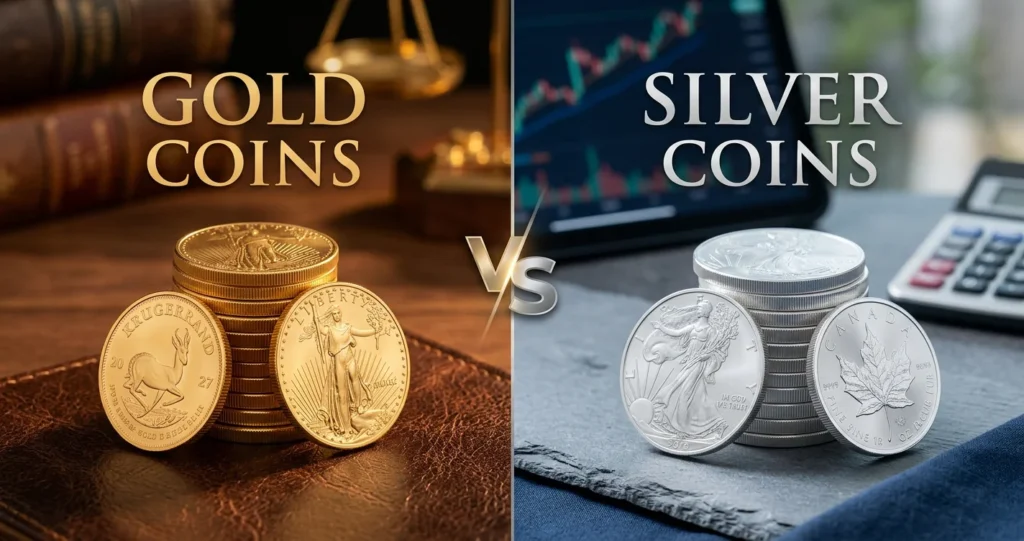
Walk into any coin shop or precious metals dealer, and the question hangs in the air before you even open your wallet: gold or silver? It’s a debate that has persisted among investors, collectors, and financial advisors for generations, and there’s no single correct answer. Each metal offers distinct advantages, carries unique risks, and behaves differently under various economic conditions.
Gold represents concentrated wealth — a single coin can hold thousands of dollars of value in a space smaller than a bottle cap. Silver offers accessibility and industrial demand that gold lacks. Both have preserved purchasing power across millennia, outlasting every fiat currency ever created. But when it comes to putting your money to work today, the choice between gold coins and silver coins involves tradeoffs that deserve careful thought.
This guide examines both metals honestly, comparing their strengths and weaknesses as investment vehicles. Whether you’re a first-time buyer weighing your options or an experienced stacker reconsidering your allocation, you’ll walk away with a clearer understanding of which metal — or which combination — fits your goals.
A Brief History of Gold and Silver as Money
Gold and silver didn’t become valuable because someone decided they should be. Their monetary roles emerged naturally over thousands of years because both metals share properties that make them ideal for use as money: durability, divisibility, portability, uniformity, limited supply, and inherent beauty.
Silver served as the everyday currency of most civilizations. The word “money” in many languages derives from words for silver — the French “argent,” the Spanish “plata.” Ordinary people conducted daily business with silver coins.
Gold, being rarer and more valuable by weight, served as the metal of kings, international trade, and large transactions. Gold coins settled debts between nations while silver coins bought bread at the market.
This historical relationship still echoes in today’s precious metals market. Gold remains the prestige metal, the ultimate store of value, while silver occupies a dual role as both a monetary metal and an essential industrial commodity.
Gold Coins as an Investment
The Case for Gold
Gold’s greatest strength is stability. It’s the asset people flee to during financial crises, geopolitical upheaval, and currency devaluations. Central banks around the world hold gold reserves — not silver — as the foundation of their monetary credibility. When confidence in paper currencies wavers, gold prices tend to rise.
Gold also offers extraordinary value density. A single American Gold Eagle one-ounce coin, roughly the diameter of a half dollar, holds over $2,300 in value at current prices. You can carry a substantial portion of your net worth in a pocket. Try doing that with silver, and you’ll need a wheelbarrow.
This compact value translates to practical advantages in storage and transportation. A $100,000 gold position fits inside a small safe deposit box. The equivalent in silver weighs approximately 200 pounds and requires far more space.
Popular Gold Coins for Investment
| Coin | Purity | Gold Content | Country |
| American Gold Eagle | 91.67% (22 karat) | 1 troy oz (also 1/2, 1/4, 1/10 oz) | United States |
| American Gold Buffalo | 99.99% (24 karat) | 1 troy oz | United States |
| Canadian Gold Maple Leaf | 99.99% (24 karat) | 1 troy oz | Canada |
| South African Krugerrand | 91.67% (22 karat) | 1 troy oz | South Africa |
| Austrian Philharmonic | 99.99% (24 karat) | 1 troy oz | Austria |
These coins are recognized worldwide, highly liquid, and easy to authenticate. Their premiums above the spot gold price typically range from 3% to 8% for one-ounce versions, making them efficient vehicles for gold exposure.
Gold’s Limitations
Gold’s primary drawback for many investors is its price point. At over $2,300 per ounce, buying even a single one-ounce gold coin requires a substantial commitment. Fractional gold coins (1/10 oz, 1/4 oz, 1/2 oz) exist, but they carry disproportionately higher premiums — sometimes 8% to 15% above spot — making them less cost-efficient.
Gold also doesn’t generate income. It pays no dividends, no interest, and no rent. Its return comes entirely from price appreciation. During periods of strong economic growth and rising stock markets, gold often underperforms equities and real estate.
Additionally, gold’s price movements tend to be less dramatic than silver’s. This is a strength for conservative investors seeking stability, but a limitation for those looking for larger percentage gains.
Silver Coins as an Investment
The Case for Silver
Silver’s most compelling advantage is affordability. At roughly $30 per ounce, silver is accessible to virtually any budget. A beginning investor can start accumulating meaningful positions with modest weekly purchases — something that’s much harder to do with gold.
But silver’s appeal goes far beyond entry price. Silver has a characteristic that gold largely lacks: massive industrial demand. Approximately 50% of global silver consumption goes toward industrial applications including electronics, solar panels, medical devices, water purification, and electric vehicles. This industrial demand creates a consumption-driven floor under silver prices and ties the metal’s fortunes to global economic growth and technological advancement.
Solar energy alone is transforming silver’s demand profile. Each standard solar panel uses approximately 20 grams of silver. As the world accelerates its transition toward renewable energy, silver consumption for photovoltaics is projected to grow substantially in the coming decades. No viable substitute has been found for silver in this application.
Silver also tends to outperform gold in percentage terms during precious metals bull markets. When gold rises 50%, silver often rises 100% or more. This amplified volatility works like leverage — magnifying gains during uptrends. Of course, it also magnifies losses during downtrends, a risk we’ll address shortly.
Popular Silver Coins for Investment
| Coin | Purity | Silver Content | Country |
| American Silver Eagle | 99.9% | 1 troy oz | United States |
| Canadian Silver Maple Leaf | 99.99% | 1 troy oz | Canada |
| Austrian Silver Philharmonic | 99.9% | 1 troy oz | Austria |
| British Silver Britannia | 99.9% | 1 troy oz | United Kingdom |
| Pre-1965 U.S. 90% Silver Coins | 90% | Varies by denomination | United States |
Pre-1965 U.S. silver coins — commonly called “junk silver” despite having nothing junk about them — deserve special mention. These circulated dimes, quarters, and half dollars offer the lowest premiums of any silver coins, typically trading at just 2% to 7% above melt value. They’re instantly recognizable, require no assay, and are divisible down to small increments, making them exceptionally practical for both investment and potential use as barter currency.
Silver’s Limitations
Silver’s biggest practical challenge is bulk. One thousand dollars of silver weighs roughly two pounds. One hundred thousand dollars of silver weighs over 200 pounds and fills multiple large containers. Storage costs, insurance premiums, and transportation logistics all become meaningful considerations at scale.
Silver’s higher volatility is a double-edged sword. While it magnifies gains, it also produces gut-wrenching drawdowns. Silver dropped from nearly $50 per ounce in 2011 to below $14 in 2015 — a 72% decline. Investors who bought near the peak waited over a decade to recover their investment. Gold, by comparison, fell about 45% during the same period and recovered more quickly.
Premiums on silver coins also tend to be higher in percentage terms than gold. A one-ounce American Silver Eagle might carry a $4 to $7 premium above spot, representing 13% to 23% of the coin’s total cost. That premium must be recouped before the investor breaks even, creating a headwind that gold investors face to a lesser degree.
Gold vs Silver: Head-to-Head Comparison
| Factor | Gold Coins | Silver Coins |
| Price per ounce (approximate) | $2,300+ | $30+ |
| Accessibility for small budgets | Limited (fractional coins carry high premiums) | Excellent |
| Value density | Very high — easy to store and transport | Low — bulky and heavy at scale |
| Volatility | Moderate | High |
| Industrial demand | Minimal (roughly 10% of supply) | Substantial (roughly 50% of supply) |
| Typical bullion premium | 3%–8% | 7%–23% |
| Performance in bull markets | Strong, steady gains | Explosive, larger percentage gains |
| Performance in bear markets | More resilient, smaller declines | Steeper declines, slower recovery |
| Central bank demand | Strong and growing | Minimal |
| Numismatic potential | High for classic U.S. gold coins | High for key-date silver coins |
| Liquidity | Excellent worldwide | Excellent, but large quantities take more effort to sell |
The Gold-to-Silver Ratio: A Strategic Tool
The gold-to-silver ratio measures how many ounces of silver it takes to buy one ounce of gold. If gold trades at $2,400 and silver at $30, the ratio is 80:1. This ratio has fluctuated throughout history and provides a useful — though imperfect — framework for deciding which metal offers better relative value at any given time.
Historical Context
The historical average of the gold-to-silver ratio over the past century sits around 60:1 to 65:1. In extreme precious metals bull markets, the ratio has compressed to 30:1 or lower (meaning silver outperformed). During risk-off environments when investors flee to gold’s perceived safety, the ratio has expanded to 100:1 or higher.
How Investors Use the Ratio
When the ratio is high (above 80:1), silver is historically cheap relative to gold, and some investors favor silver purchases. When the ratio is low (below 50:1), gold is relatively cheaper, and the pendulum may favor gold acquisitions. Some sophisticated investors practice ratio trading — converting between the two metals as the ratio swings, gradually accumulating more total ounces over time.
The ratio is not a crystal ball. It doesn’t predict short-term price movements, and it can remain elevated or compressed for extended periods. But it adds useful context to the gold-versus-silver decision, especially for investors with a long time horizon.
Which Metal Fits Your Situation?
Rather than declaring one metal universally superior, consider how each aligns with your specific circumstances.
Choose Gold If:
- You have substantial capital to deploy and want efficient value storage
- Storage space and logistics are concerns
- You prioritize stability over maximum upside potential
- You’re building a long-term wealth preservation strategy
- You want the metal that central banks and sovereign wealth funds favor
Choose Silver If:
- You’re starting with a smaller budget and want to build a position gradually
- You believe in silver’s industrial demand story, particularly solar energy
- You’re comfortable with higher volatility in exchange for larger potential percentage gains
- You want a metal with both monetary and practical utility
- You enjoy the collecting aspect — silver coins offer enormous variety at approachable prices
Choose Both If:
- You want diversification within your precious metals allocation
- You can adapt your purchases based on market conditions and the gold-to-silver ratio
- You appreciate the different strengths each metal brings to a portfolio
Many experienced precious metals investors maintain positions in both gold and silver, adjusting their ratio based on relative valuations and personal conviction. There’s no rule saying you must choose one or the other.
Practical Buying Tips for Both Metals
Minimize Premiums
Premiums are the cost of entry, and every dollar spent on premium is a dollar that doesn’t buy actual metal. For gold, one-ounce coins offer the best premium-to-value ratio. For silver, pre-1965 U.S. coins and generic rounds carry the lowest premiums. American Eagles and Canadian Maple Leafs cost more but offer superior liquidity and recognition.
Buy from Reputable Sources
Purchase from established dealers with verifiable track records. Online dealers like APMEX, JM Bullion, SD Bullion, and Monument Metals offer competitive pricing with transparent fee structures. Local coin shops provide the advantage of in-person inspection and no shipping delays. Whichever route you choose, verify that the dealer has a strong reputation through reviews, industry affiliations, and years in business.
Dollar-Cost Average
Rather than making a single large purchase and hoping you timed the market correctly, consider spreading your buying over weeks or months. Regular purchases at fixed dollar amounts smooth out price volatility and remove the emotional pressure of trying to pick the perfect entry point. This strategy works particularly well with silver, where even small weekly purchases accumulate meaningfully over time.
Secure Storage
A home safe bolted to the floor provides immediate access. A bank safe deposit box offers security but limits access to banking hours and raises questions about government seizure risk that some investors worry about. Third-party vaulting services like those offered by major dealers provide insured, audited storage — often at surprisingly reasonable annual fees — while keeping your metal fully allocated and segregated.
Keep Records
Document every purchase with date, quantity, price paid, premium, and source. These records are essential for calculating capital gains when you eventually sell and for insurance purposes if your collection is lost, stolen, or damaged.
The Numismatic Angle: Collector Value Beyond Bullion
For those who appreciate coins as more than metal, both gold and silver offer rich numismatic possibilities that can enhance returns beyond simple bullion appreciation.
Classic U.S. gold coins — Liberty Head and Saint-Gaudens Double Eagles, Indian Head Quarter Eagles, and Liberty Head Half Eagles — carry significant collector premiums in higher grades. A common-date $20 Saint-Gaudens Double Eagle contains roughly $2,200 in gold but sells for $2,400 to $2,800 in typical uncirculated grades. In gem condition, the same coin might fetch $5,000 to $15,000 or more.
Silver’s numismatic landscape is even broader. Morgan and Peace Dollars, Walking Liberty Half Dollars, Mercury Dimes, and Seated Liberty coinage offer collectors vast series to explore with coins available at virtually every price point. Key dates in these series can appreciate independently of silver prices, providing a second engine of potential return.
The intersection of bullion and numismatic value creates a unique dynamic: coins that are both rare and made of precious metal benefit from two separate sources of demand. During precious metals rallies, their metal value rises. During collector market booms, their numismatic premiums expand. This dual demand can provide a measure of protection against declines in either market alone.
Tax Considerations
In the United States, gold and silver coins are classified as collectibles by the IRS, subject to a maximum long-term capital gains tax rate of 28% — higher than the 15% to 20% rate applied to most stocks and bonds. This tax treatment applies to coins held for more than one year. Short-term gains on coins held less than a year are taxed as ordinary income.
Certain gold and silver coins qualify for inclusion in Individual Retirement Accounts (IRAs), which offer tax-deferred or tax-free growth depending on the account type. American Eagles, American Buffalos, Canadian Maple Leafs, and Australian Kangaroos all meet IRA purity requirements. A precious metals IRA requires a specialized custodian and approved depository, adding complexity and fees, but the tax advantages can be substantial for larger allocations.
Always consult a qualified tax professional before making significant precious metals investments. Tax rules vary by jurisdiction and change periodically.
Frequently Asked Questions
1. Is gold or silver a better hedge against inflation?
Both metals have historically served as inflation hedges, but gold has a stronger track record in this role. Gold tends to respond more directly to monetary policy and currency debasement, while silver’s price is also influenced by industrial demand, which can decline during recessions even as inflation rises. During the inflationary 1970s, both metals performed exceptionally well, but gold’s gains were more consistent while silver’s were more explosive and volatile. For pure inflation protection, gold is the more reliable choice. For potentially larger gains in an inflationary environment, silver offers greater upside with greater risk.
2. How much of my portfolio should be in precious metals?
Financial advisors who recommend precious metals typically suggest allocating 5% to 15% of a diversified portfolio, with the exact percentage depending on your risk tolerance, investment timeline, and economic outlook. This allocation provides meaningful protection against currency debasement and financial system risk without overexposing you to a non-income-producing asset class. Within that allocation, a common split is 60% to 75% gold and 25% to 40% silver, though personal preferences and market conditions should guide your specific ratio.
3. Can I lose money investing in gold or silver coins?
Yes. Despite their reputation as safe havens, precious metals can and do decline in value — sometimes significantly. Silver dropped over 70% between 2011 and 2015. Gold fell roughly 45% during the same period. Investors who buy at cyclical peaks and sell during downturns can experience real losses. Additionally, premiums paid above spot price represent an immediate unrealized loss that must be recovered through price appreciation before breaking even. Precious metals should be viewed as long-term holdings and portfolio diversifiers, not guaranteed profit generators.
4. Are numismatic gold and silver coins better investments than bullion coins?
Not necessarily. Numismatic coins can deliver outstanding returns when purchased wisely, but they require specialized knowledge to evaluate and carry risks that bullion doesn’t — including overpaying for inflated grades, buying coins with undisclosed problems, or investing in series that fall out of collector favor. Bullion coins are straightforward: their value tracks the metal price plus a modest premium. For most investors, particularly beginners, bullion coins are the more appropriate choice. Numismatic coins are best pursued by those who genuinely enjoy the collecting process and are willing to invest time in education.
5. Should I buy coins or bars for investment purposes?
For gold, both coins and bars work well. Government-issued coins offer guaranteed weight and purity, instant recognition, and potential numismatic premiums. Bars, particularly from reputable refiners like PAMP Suisse or Valcambi, carry slightly lower premiums but may require assay verification when resold. For silver, coins generally outperform bars in terms of liquidity and resale convenience, though bars offer lower per-ounce premiums for investors focused purely on accumulating metal. Many investors use a combination — coins for their core holdings and bars for additional accumulation when premiums on coins spike.
Conclusion
The gold versus silver debate doesn’t have a winner because the two metals serve fundamentally different roles. Gold is the anchor — steady, compact, and universally respected as the ultimate monetary asset. Silver is the accelerator — affordable, industrially vital, and capable of delivering outsized returns during precious metals bull markets.
Your ideal allocation depends on factors no article can determine for you: your financial situation, risk tolerance, investment timeline, storage capabilities, and personal convictions about the economic future. What we can say with confidence is that both metals have proven their worth across centuries and civilizations, and both deserve consideration in a well-constructed portfolio.
Start where you are. If gold feels out of reach, silver offers a welcoming entry point. If you can afford gold, its stability and value density are hard to beat. If you can manage both, you get the best of both worlds — the anchor and the accelerator working together.
Whatever you choose, buy smart, store safely, think long-term, and never invest money you can’t afford to set aside for years. Precious metals reward patience. They always have.