
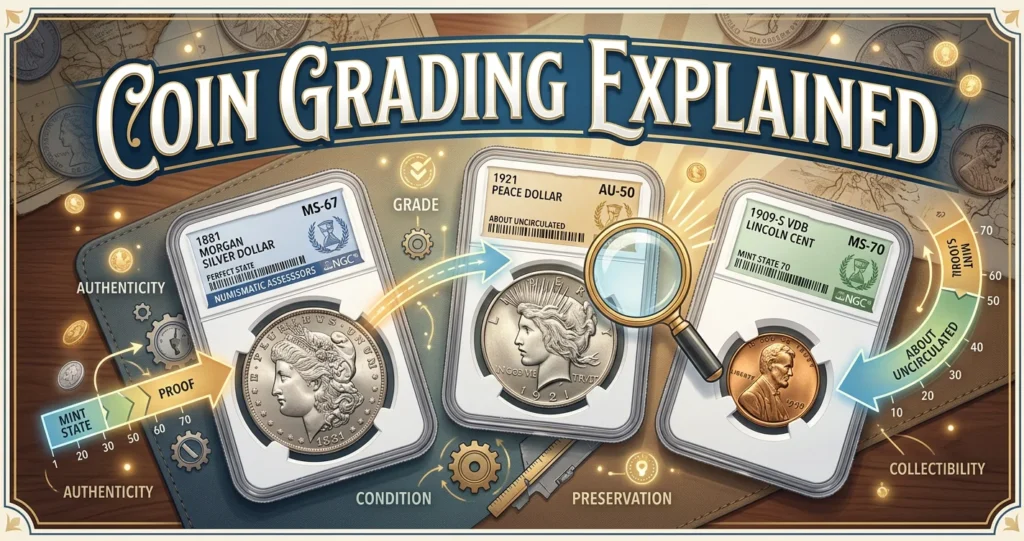
Imagine two identical coins — same year, same mint mark, same denomination. One sells for $50. The other fetches $15,000. The difference? Condition. In the world of numismatics, the physical state of a coin can multiply its value by a factor of ten, a hundred, or even a thousand. And the system used to evaluate that condition is called coin grading.
For newcomers, coin grading can feel intimidating. The terminology is unfamiliar, the scale seems arbitrary, and the stakes are high. A single grade point can mean a difference of thousands of dollars. But here’s the good news: the fundamentals aren’t difficult to learn. Once you understand how grading works, you’ll look at every coin differently — and you’ll make far better decisions as a collector, buyer, or seller.
This guide breaks down the coin grading system from the ground up. No prior experience required. By the end, you’ll understand the grading scale, know what professional graders look for, and have the confidence to start evaluating coins on your own.
What Is Coin Grading?
Coin grading is the process of evaluating a coin’s physical condition and assigning it a standardized numerical score. That score tells collectors and dealers exactly how well-preserved a coin is, which directly impacts its market value.
Think of it like grading a used car. Two 1967 Mustangs might have the same engine and paint color, but one has been garaged its entire life while the other spent decades in a field. A mechanic can assess the difference. Coin grading does the same thing — it quantifies wear, damage, and preservation so that buyers and sellers share a common language.
Before standardized grading existed, coin transactions relied on vague descriptive terms that meant different things to different people. A coin described as “fine” by one dealer might be called “very fine” by another. This inconsistency created confusion, disputes, and opportunities for dishonest sellers to take advantage of inexperienced buyers.
The modern grading system solved that problem.
The Sheldon Scale: The Foundation of Modern Coin Grading
In 1949, numismatist Dr. William Sheldon introduced a 70-point scale for grading large cents. Over time, this scale was adopted across all U.S. coin series and eventually became the global standard for coin grading. It ranges from 1 (a coin that’s barely identifiable) to 70 (a coin in absolutely perfect condition).
The Sheldon Scale combines a numerical grade with a descriptive abbreviation. Here’s how the full spectrum breaks down.
Circulated Grades (1–58)
Circulated coins have been used in everyday transactions. They show varying degrees of wear on their high points — the raised areas of the design that contact other surfaces most frequently.
| Grade Range | Abbreviation | Description |
| 1 | PO (Poor) | Barely recognizable. Date and type may be partially visible. |
| 2 | FR (Fair) | Heavily worn but identifiable. Major design elements visible. |
| 3 | AG (About Good) | Very heavily worn. Outline of design visible, most details gone. |
| 4–6 | G (Good) | Major design elements clear but flat. Peripheral lettering mostly readable. |
| 8–11 | VG (Very Good) | Design is clear with some detail remaining in protected areas. |
| 12–15 | F (Fine) | Moderate wear on high points. Roughly half the original detail remains. |
| 20–35 | VF (Very Fine) | Light to moderate wear on high points. Most design details are sharp. |
| 40–45 | EF/XF (Extremely Fine) | Slight wear on highest points only. Nearly full detail with some luster remaining. |
| 50–58 | AU (About Uncirculated) | Trace wear on the very highest points. Significant original mint luster present. |
Uncirculated Grades (60–70)
Uncirculated coins — also called Mint State (MS) coins — show no wear from circulation. However, they can still have imperfections from the minting process or from contact with other coins during production and storage. These imperfections are called “contact marks” or “bag marks.”
| Grade | Abbreviation | Description |
| 60–61 | MS-60/MS-61 | No wear but abundant contact marks, possibly reduced luster or unattractive toning. |
| 62–63 | MS-62/MS-63 | Above average for an uncirculated coin. Fewer marks, better eye appeal. |
| 64 | MS-64 | Few noticeable marks. Good luster and strike. Attractive overall appearance. |
| 65 | MS-65 (Gem) | Strong luster, sharp strike, only minor marks not immediately visible. Excellent eye appeal. |
| 66–67 | MS-66/MS-67 (Superb Gem) | Virtually mark-free with outstanding luster and strike. Exceptional quality. |
| 68–69 | MS-68/MS-69 | Near perfection. Only the slightest imperfections visible under magnification. |
| 70 | MS-70 (Perfect) | Flawless under 5x magnification. No marks, perfect strike, full luster. |
The jump from MS-64 to MS-65 is one of the most significant price breaks in numismatics. A coin graded MS-65 is considered “Gem” quality, and the premium for reaching that threshold can be substantial. For example, a common-date Morgan Silver Dollar in MS-64 might sell for $125, while the same coin in MS-65 could bring $250 to $400.
Proof Coins: A Separate Category
Proof coins are specially manufactured coins struck with polished dies on polished planchets, usually multiple times, to create a sharp, mirror-like finish. They’re made for collectors, not for circulation. Proof coins use a parallel grading scale with the prefix “PR” or “PF” instead of “MS.”
A Proof-65 coin, for instance, has the same general quality expectations as an MS-65 coin but is evaluated against proof standards. Proof coins are judged on mirror quality, contrast between frosted devices and reflective fields (known as “cameo” or “deep cameo”), and the absence of hairlines — fine scratches often caused by improper handling.
Cameo and Deep Cameo Designations
When a proof coin displays strong contrast between its frosted raised elements and its mirror-like flat surfaces, grading services may add a “Cameo” (CAM) or “Deep Cameo” (DCAM) designation. Deep Cameo proofs, with their heavy, even frost, are the most visually striking and typically command the highest premiums.
The Four Pillars of Coin Grading
Professional graders evaluate coins based on four main criteria. Understanding these factors will sharpen your eye and help you assess coins before submitting them for professional grading.
1. Surface Preservation
This refers to the overall condition of the coin’s surfaces. Graders look for contact marks, scratches, hairlines, rim dings, and any form of post-minting damage. The location of marks matters too — a bag mark hidden in a busy area of the design is less damaging to the grade than one sitting prominently on a cheek or open field.
2. Strike Quality
Strike describes how well the coin’s design was impressed onto the planchet during minting. A fully struck coin shows complete, crisp detail in every element of the design. A weakly struck coin may have mushy or incomplete details, even if it has never been circulated. Certain coin types are notorious for weak strikes — Standing Liberty Quarters and Franklin Half Dollars, for example — which makes well-struck examples particularly desirable.
3. Luster
Luster is the way light reflects off the microscopic flow lines created during the striking process. A coin with full, vibrant luster appears to glow when tilted under a light source. This cartwheel effect is one of the first things to diminish when a coin enters circulation. Cleaning, polishing, and environmental damage can also destroy luster permanently.
4. Eye Appeal
This is the most subjective factor, but it’s genuine and important. Eye appeal encompasses the overall visual impression a coin makes. Two coins with identical technical attributes can have different levels of eye appeal based on toning, surface quality, and aesthetic harmony. A coin with exceptional eye appeal may receive a slight bump in grade, while an ugly coin with the same technical merits might be graded conservatively.
Professional Grading Services: PCGS vs. NGC
Two companies dominate the professional coin grading industry: PCGS (Professional Coin Grading Service) and NGC (Numismatic Guaranty Company). Both are respected, widely accepted, and provide authentication alongside grading.
How Professional Grading Works
When you submit a coin, multiple expert graders independently evaluate it without knowing each other’s assessments. The final grade is determined by consensus. The coin is then encapsulated in a tamper-evident plastic holder (called a “slab”) with a label displaying the grade, certification number, and other relevant information.
Each grading service maintains an online database where buyers can verify a coin’s certification, providing an additional layer of security against counterfeiting and tampering.
PCGS vs. NGC: Which Should You Choose?
| Feature | PCGS | NGC |
| Founded | 1986 | 1987 |
| Reputation | Often considered slightly tighter in grading standards for U.S. coins | Widely respected, sometimes preferred for world coins |
| Price Guide | PCGS CoinFacts (comprehensive U.S. coin database) | NGC Coin Explorer (extensive global coverage) |
| Market Premium | Some U.S. coin series command a slight premium in PCGS holders | Generally comparable pricing for most coins |
| Submission Cost | Starts around $22 per coin (economy tier) | Starts around $22 per coin (economy tier) |
In practice, either service is perfectly acceptable. Many experienced collectors submit to both, depending on the coin type and their personal preferences. What matters most is that you use one of these two services rather than lesser-known grading companies, which may not be recognized or trusted in the broader market.
Should You Get Your Coins Professionally Graded?
Professional grading isn’t necessary for every coin. It makes financial sense in specific situations.
- The coin’s estimated value exceeds $100. Below this threshold, the grading fee may eat into or exceed the coin’s value.
- You plan to sell the coin. Graded coins sell faster and for higher prices because buyers trust the certified grade.
- You want authentication. If there’s any doubt about a coin’s genuineness, professional services can confirm or deny authenticity.
- You’re building a registry set. Both PCGS and NGC offer online registries where collectors compete to assemble the highest-graded sets in specific series.
- The coin is rare or high-grade. For coins where a one-point grade difference means thousands of dollars, professional certification is essential.
For common coins worth a few dollars each, grading is unnecessary. Your money is better spent acquiring more coins or investing in reference books and supplies.
Common Grading Mistakes Beginners Make
Learning to grade takes time and practice. Here are pitfalls to watch for as you develop your skills.
Confusing Weak Strike with Wear
A weakly struck coin can look worn even though it’s uncirculated. The difference is in the luster — a weakly struck coin will still have original mint luster in the flat areas, while a worn coin will show luster loss on the high points. Learning this distinction takes practice but prevents costly mistakes.
Overgrading Your Own Coins
Everyone does it. When you own a coin, you want it to be as nice as possible. Bias is natural, but it leads to disappointment when professional grades come back lower than expected. Combat this by comparing your coins to images of professionally graded examples at the grade you believe yours to be. Online databases from PCGS and NGC provide photographs of graded coins that serve as excellent benchmarks.
Ignoring Cleaning and Artificial Toning
Cleaned coins are one of the biggest traps for beginners. A coin that has been cleaned with an abrasive or dipped in a chemical solution may appear bright and attractive, but experienced eyes can spot the unnatural surfaces. Cleaned coins receive a “Details” grade from professional services, which significantly reduces their market value — often by 30% to 60% compared to a problem-free coin of the same grade level.
Artificial toning — color added deliberately to mimic natural patina — is another concern. Natural toning develops over decades and displays characteristic color progressions. Artificial toning often looks too vivid, too uniform, or appears in suspicious patterns.
Neglecting Edge and Rim Examination
Many beginners focus exclusively on the obverse and reverse faces of a coin while overlooking the edge and rim. Rim nicks, edge bumps, and damage in these areas affect the grade. Always examine the coin’s full three-dimensional surface.
Practical Tips for Learning to Grade Coins
- Handle coins properly. Hold coins by their edges only. Fingerprints on surfaces can cause permanent damage over time.
- Use proper lighting. A single-point light source (like a desk lamp with an incandescent or daylight LED bulb) held at a 45-degree angle reveals surface details, luster patterns, and marks far better than overhead fluorescent lighting.
- Invest in a quality loupe. A 7x to 10x magnification jeweler’s loupe is essential. Higher magnification isn’t necessary and can actually make grading harder by overemphasizing minor imperfections.
- Study grading guides. “The Official American Numismatic Association Grading Standards for United States Coins” (commonly called the ANA Grading Guide) provides detailed descriptions and photographs for every grade level across all major coin types.
- Attend coin shows. Nothing accelerates learning like handling real coins alongside experienced collectors and dealers willing to share knowledge. Most coin shows welcome beginners warmly.
- Practice with inexpensive coins. Build a reference set of common coins at different grade levels. Having physical examples to compare against is invaluable.
Frequently Asked Questions About Coin Grading
1. Can the same coin receive different grades from different grading services?
Yes, and it happens regularly. Grading involves professional judgment, and minor differences in interpretation are inevitable. A coin graded MS-64 by one service might receive MS-65 from another — or vice versa. This is why some collectors “crack out” coins from their holders and resubmit them, hoping for a higher grade on a second evaluation. The practice is controversial but common, and it underscores the fact that grading is not an exact science despite its numerical precision.
2. Does toning on a coin affect its grade?
Natural toning itself doesn’t lower a coin’s grade and can actually enhance its value if the colors are attractive. Brilliant blues, violets, and golds on silver coins, for example, are highly prized. However, dark, blotchy, or uneven toning that obscures design details can negatively affect eye appeal and may result in a lower grade. The key distinction is between toning that adds beauty and toning that detracts from it.
3. What does “Details” grade mean?
When PCGS or NGC assigns a “Details” grade — such as “AU Details, Cleaned” — it means the coin has a problem that prevents it from receiving a straight numeric grade. Common problems include cleaning, environmental damage, scratches, tooling, mounting evidence, and artificial color. The grade tells you what the coin would have graded without the problem, but the designation significantly reduces its market value compared to a problem-free coin.
4. How much does professional grading cost?
Economy-tier submissions at PCGS and NGC start at approximately $22 to $30 per coin, but these services have lengthy turnaround times — sometimes several months. Faster service tiers are available at higher prices, ranging from $40 for standard service up to $300 or more for same-day grading of high-value coins. Both services also charge annual or per-submission membership fees. For most collectors, the economy tier provides excellent value if you can wait for results.
5. Can I learn to grade coins accurately without professional training?
Absolutely, though it takes dedication and practice. Many skilled graders are self-taught collectors who spent years studying grading guides, examining thousands of coins at shows and shops, and comparing their assessments against professional grades. You may never agree with every professional grade — few experts do — but you can develop enough proficiency to make informed buying and selling decisions. Start with one coin series you’re passionate about and learn it deeply before branching out.
Conclusion
Coin grading is the bridge between admiring a coin and truly understanding its value. It transforms subjective impressions into a shared language that collectors, dealers, and investors around the world rely on every day. While the system can seem complex at first, the core concepts are straightforward: better-preserved coins are worth more, and standardized grading helps everyone agree on what “better preserved” actually means.
As a beginner, your goal isn’t to become a professional grader overnight. It’s to develop enough understanding to examine coins with an informed eye, recognize obvious problems, and make smarter decisions about what you buy and sell. Every coin you study sharpens your skill. Every comparison you make between a known grade and your own assessment builds your confidence.
Start with the basics outlined here. Pick up a loupe, study the grading guides, and — most importantly — look at as many coins as you can. The ability to accurately assess a coin’s condition is one of the most valuable skills in numismatics, and it’s one that will serve you well for as long as you collect.